Cleaning agents
Certain cargoes require the use of a cleaning agent for efficient cleaning. Most cleaning agents are additives which are used in combination with water to improve the water solubility of the cargo to be cleaned. Only certain cleaning jobs which cannot be performed with water based systems require another not water based additive as a cleaner.
Cleaning agents must be IMO approved. Check for approval status in the list of approved cleaning additives. 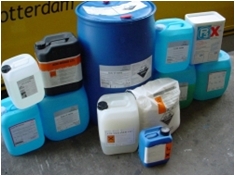
The reason for recommending certain additives in MIRACLE recipes is that the authors have in depth experience with these products.
Alternative cleaner types could be used as a substitute in the MIRACLE cleaning suggestions for a similar cleaning job.
Different cleaner concentrations, times and temperatures in the respective cleaning steps could be required to achieve a satisfactory result.
A cleaner selection table is available in the MIRACLE cleaning recipes. Just a manual selection of the applicable cleaning job is required from the user. Thereafter a selection of the applicable cleaner types and the most common cleaners is listed. In addition the most important manufacturer recommendations regarding concentration, temperature, coating suitability and water quality requirements can be retrieved from this list.
The following is a list of the cleaner types that could be required for the desired cleanliness.
-
Alkaline
Alkaline (Caustic Potash)
– Based on Potassium Hydroxide.
– Saponification of vegetable and animal oils and fats
– Producing soft soaps during saponification and are therefore more effective than caustic based cleaners.
– Compared with Caustic based alkaline cleaners lower risk of formation of white residues
– To be used in fresh water onlyAlkaline (Caustic Soda)
– Based on Sodium Hydroxide
– Saponification of vegetable and animal oils and fats
– Producing hard soaps during saponification of vegetable oils
– Risk of formation of white residues at higher temperatures (carbonates)
– To be used in fresh water onlyAlkaline Safety (Zinc)
– Weak alkaline cleaner with suitable pH-Value for zinc coating.
– To be used in fresh water only
-
Detergent
– Wide variety of different products ranging from standard soaps to sophisticated high performance detergents with a wide range of possible application.
– Surface active agents
– Emulsification
– Depending on product usable in fresh water or sea water
-
Combination Cleaner
– Combination of two different type of cleaners for example an Alkaline cleaner mixed with a detergent based cleaner.
– Boosting of cleaning performance
– A wider range of possible application
– To be used in fresh water only
-
Metalbright/Rust remover
– Acid cleaner based on Phosphoric acid
– Removal of white residues like carbonates from caustic or calcium and magnesium soaps from vegetable oils and vegetable fatty acids.
– Removal of rust
– Upgrade (brightening) of stainless steel cargo tanks
– To be used in fresh water only
-
Solvent cleaner
Solvent Cleaner(Hydrocarbon based)
– Based on Petroleum solvents
– Solving of residues from black oils and heavy mineral oil contamination
– Can normally be used in fresh water as well as in sea waterSolvent Cleaner(Hydrocarbon free)
– Based on water soluble solvents like Gycols, Glycolethers or Ketones
– Removal of Hydrocarbons
– Use in fresh water is recommendedSolvent cleaner(other)
– Based on other solvents like halogenated/chlorinated solvents
– Application for specific cleaning jobs
– Products can be harmful/toxic
– Use in fresh water is recommended
-
Inert Gas Remover
– Specifically designed alkaline cleaner for removal of residues from soot and combustion
– To be used in fresh water only
-
Smell Remover
– Removal of smell from cargoes causing a strong odour.
– Different type of cleaners with deodorizing and non-deodorizing components.
– Different application requirements (recirculation, spraying, steaming additive etc.)