Persistent floaters
Background
Pollution of north European coastlines is assumed to be partly the result of tank cleaning residues after carriage of vegetable oils and paraffin waxes.
Hence, amendments to MARPOL Annex II imposing prewash requirements for certain high-viscosity or low-melting-point, floating, products with low water solubility and low volatility have been adopted.
This resulted in amendments to MARPOL Annex II (Cargo residues and tank washings of persistent floating products).
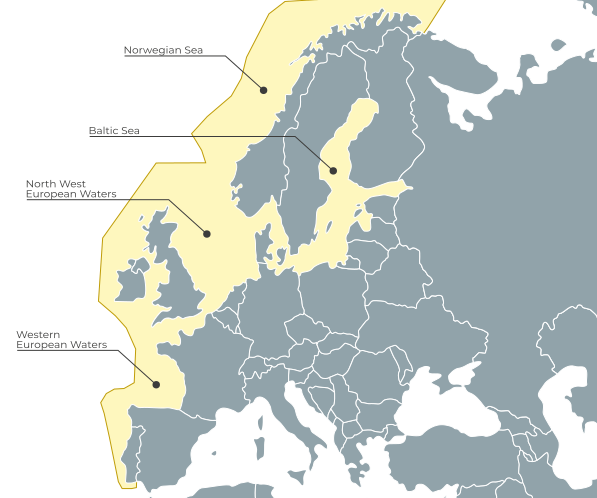
These products can be found in the list below. Cleaning after carrying these cargoes in European waters specified in map below requires a prewash as if they were solidifying or high viscosity cargoes. See the procedure below.
Definition
Persistent floater means a slick forming substance with the following properties:
– Density: ≤ sea water (1025 kg/m3 at 20°C);
– Vapour pressure: ≤ 0.3 kPa;
– Solubility: ≤ 0.1% (for liquids) ≤ 10% (for solids); and
– Kinematic viscosity: > 10 cSt at 20°C.
Control of discharges
For substances assigned to category Y that are persistent floaters with a viscosity equal to or greater than 50 mPa*s at 20ºC and/or with a melting point equal to or greater than 0ºC, as identified by ‚16.2.7‘ in column ‚o‘ of chapter 17 of the IBC Code, the following shall apply in the areas in paragraph 9 (see below):
.1 a prewash procedure as specified in appendix VI of Marpol Annex II shall be applied;
.2 the residue/water mixture generated during the prewash shall be discharged to a reception facility at the port of unloading until the tank is empty; and
.3 any water subsequently introduced into the tank may be discharged into the sea in accordance with the discharge standards in regulation 13.2 of Annex II.
Areas where persistent floaters must be prewashed acc to Marpol Annex II Reg 13 § 9