Phases
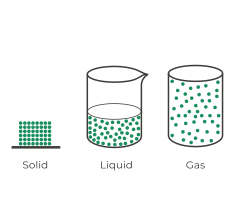
Solid Liquid Gas
We can classify most materials as solids, liquids or gases. The primary distinction between these phases deals with the attractions/forces between the atom
a.
Solids have strong intramolecular (between molecule) forces that hold the atoms or molecules together. Each molecule interacts closely with those around it and has very little freedom to change position. Solids that have an ordered array of atoms/molecules are called crystalline solids. Those that have no long-range order are called amorphous.
b.
Liquids have somewhat weaker interactions between the atoms or molecules. The molecules can move fairly freely past one another, and the material will tend to take the shape of its container. Liquids have no long-range order and very little short-range order.
c.
Gases have little or no interactions between the atoms or molecules. The distance between adjacent molecules is many times larger than in liquids and solids. Gases generally diffuse, spacing themselves throughout the container. We can express these states of matter pictorially. Of course, the molecules are shown millions of times their actual size:
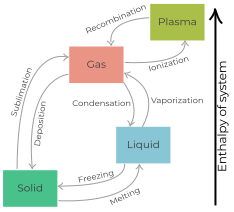
It is quite common for materials to undergo phase transitions, i.e. a change between one state and another. For example, solids can melt to give liquids; the reverse process is freezing. Liquids can evaporate into gases; the reverse process is called condensation. Solids can sublime to give gases without ever forming a liquid; the reverse process is called deposition.