SOLAS requirements for Inert Gas Systems
Inerting and Purging requirements depend on flashpoint, age and size of ship and tank size
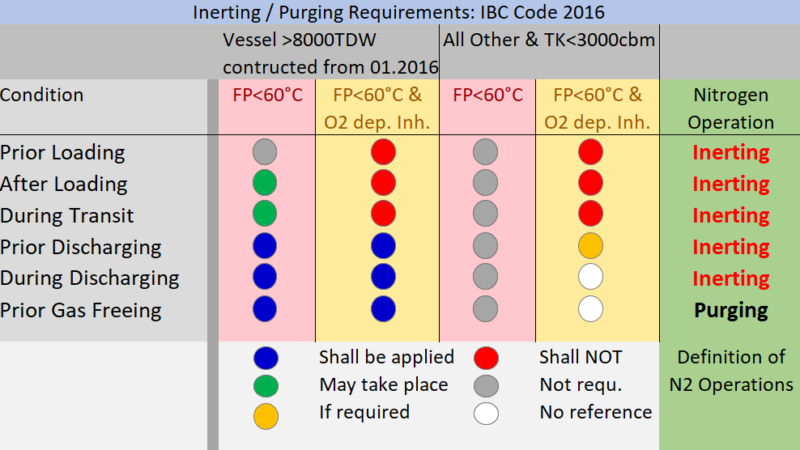
Inert Gas System Requirements on Board New Build Tankers From 1 January 2016
Oil and Chemical Tankers
The amendments to SOLAS regulations II-2/4.5.5 and II 2/16.3.3 require an inert gas system to be fitted on all new oil and chemical tankers of 8,000 dwt and above, (when transporting low-flash point cargoes of <60°C). Oil tankers above 20,000 dwt were already required to install such systems.
For tankers fitted with exhaust gas inerting systems, the application of inert gas must be carried out during loading, on passage, unloading, tank cleaning and purging prior to gas freeing.
However, for chemical tankers, the application of inert gas may take place after the cargo tank has been loaded, but before the commencement of unloading (only if nitrogen is used as the inerting medium) and shall continue to be applied until that cargo tank has been purged of all flammable vapours before gas freeing.
The oxygen limit (all tankers) for inert gas supplied to cargo tanks has also been lowered from 8% to 5% for new systems.
Chemical Tankers
The exemption for existing chemical tankers with tank volumes not exceeding 3,000 m3, fitted with tank cleaning machines with a throughput not exceeding 17.5 m3/h (per nozzle) and a total combined throughput not exceeding 110 m3/h, does not apply to chemical tankers delivered after 1st January 2016.
Related draft amendments to the International Code for Fire Safety Systems (FSS Code) were also agreed, resulting in a complete replacement of chapter 15 (Inert Gas Systems).