Viscosity
Viscosity is the resistance of a fluid to flow. This resistance acts against the motion of any solid object through the fluid and also against the motion of the fluid itself past stationary obstacles. Viscosity also acts internally on the fluid between slower and faster moving adjacent layers.
All fluids, i.e., all liquids and gases, exhibit viscosity to some degree. Viscosity may be thought of as fluid friction, just as the friction between two solids
resists the motion of one over the other but also makes possible the acceleration of one relative to the other (e.g., the friction between the wheels of an automobile and a highway), so viscosity resists the motion of a solid through a fluid but also makes it possible for a propeller or other device to accelerate the solid through the fluid.
Viscosity diminishes as temperature rises, often by about 2% per degree C; it also increases with an increase in pressure.
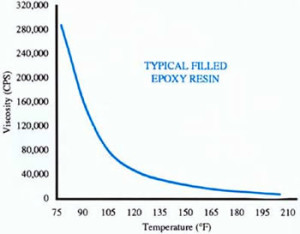
To reduce the viscosity of paste materials to allow easier pumping, heat is often applied. The following graph illustrates how a typical filled epoxy resin reduces in viscosity as it is heated.
-
Tank cleaning of High Viscosity cargoes
- Watch IBC chapter 17 column o (specific and operational requirements, minimum discharge temperature) for 16.2.6
- Washing at higher temperatures. Viscosity decreases with increasing temperature.
- No cold adjacent cargoes, no adjacent ballast water.
- If high viscosity cargo has been discharged wash a.s.a.p.
Units:
Dynamic Viscosity μ
Measurement units: Pascal second (Pa * s) ; 1 Pa * s = 1000 milli Pacal seconds (mPa * s) or Poise, 1Poise = 100 centi Poise (cP)
1cP = 1mPa * s Viscosity of Water @ 20°C= 1cP
Kinematic Viscosity ν
Measurement units: m²/s ; Stoke ; 1 Stoke = 100 cSt ; Sayboldt Universal (SSU)
Densityρ (g/cm³ = kg/liter)
Dynamic Viscosity =“ Kinematic“ Viscosity * Density
1cP = 1cSt * 1g/cm³
Typical Viscosity Values (mPa * s = cP) of liquids @ 25°C
Ethanol 1,07
Olive Oil 81
HFO 380 2022
Pitch 230.000.000
-
Viscosity Conversion Chart
The following viscosities are based on materials with a specific gravity of one.
Centipoise (cP) or Millipascal (mPas) Poise (P) Centistokes (cSt) Stokes (St) Saybolt Universal (SSU) 1 0.01 1 0.01 31 2 0.02 2 0.02 34 4 0.04 4 0.04 38 7 0.07 7 0.07 47 10 0.1 10 0.1 60 15 0.15 15 0.15 80 20 0.2 20 0.2 100 25 0.24 25 0.24 130 30 0.3 30 0.3 160 40 0.4 40 0.4 210 50 0.5 50 0.5 260 60 0.6 60 0.6 320 70 0.7 70 0.7 370 80 0.8 80 0.8 430 90 0.9 90 0.9 480 100 1 100 1 530 120 1.2 120 1.2 580 140 1.4 140 1.4 690 160 1.6 160 1.6 790 180 1.8 180 1.8 900 200 2 200 2 1000 220 2.2 220 2.2 1100 240 2.4 240 2.4 1200 260 2.6 260 2.6 1280 280 2.8 280 2.8 1380 300 3 300 3 1475 320 3.2 320 3.2 1530 340 3.4 340 3.4 1630 360 3.6 360 3.6 1730 380 3.8 380 3.8 1850 400 4 400 4 1950 420 4.2 420 4.2 2050 440 4.4 440 4.4 2160 460 4.6 460 4.6 2270 480 4.8 480 4.8 2380 500 5 500 5 2480 550 5.5 550 5.5 2660 600 6 600 6 2900 700 7 700 7 3380 800 8 800 8 3880 900 9 900 9 4300 1000 10 1000 10 4600 1100 11 1100 11 5200 1200 12 1200 12 5620 1300 13 1300 13 6100 1400 14 1400 14 6480 1500 15 1500 15 7000 1600 16 1600 16 7500 1700 17 1700 17 8000 1800 18 1800 18 8500 1900 19 1900 19 9000 2000 20 2000 20 9400 2100 21 2100 21 9850 2200 22 2200 22 10300 2300 23 2300 23 10750 2400 24 2400 24 11200 2500 25 2500 25 11600 3000 30 3000 30 14500 3500 35 3500 35 16500 4000 40 4000 40 18500 4500 45 4500 45 21000 5000 50 5000 50 23500 5500 55 5500 55 26000 6000 60 6000 60 28000 6500 65 6500 65 30000 7000 70 7000 70 32500 7500 75 7500 75 35000 8000 80 8000 80 37000 8500 85 8500 85 39500 9000 90 9000 90 41080 9500 95 9500 95 43000 15000 150 15000 150 69400 20000 200 20000 200 92500 30000 300 30000 300 138500 40000 400 40000 400 185000 50000 500 50000 500 231000 60000 600 60000 600 277500 70000 700 70000 700 323500 80000 800 80000 800 370000 90000 900 90000 900 415500 100000 1000 100000 1000 462000 125000 1250 125000 1250 578000 150000 1500 150000 1500 694000 175000 1750 175000 1750 810000 200000 2000 200000 2000 925000