Inert Gas
Inert Gas hazards
Inert Gas is principally used to control cargo tank atmospheres and so prevent the formation of flammable mixtures. The primary requirement for inert gas is low oxygen content. Its composition can, however, be variable depending on the inert gas system used to generate the gas.
The main hazard involved with inert gas is the low oxygen content that can lead to asphyxiation.
Some cargoes are carried under an inert blanket and are not flammable but the atmosphere is inerted for quality reasons. In this case a gradual decrease of inert atmosphere is acceptable. In all other cases the decrease of the inert atmosphere could result in that the mixture becomes flammable. The background for this effect is described below.
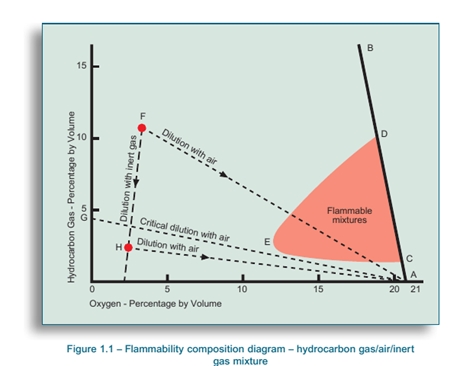
When an inert gas, is added to a hydrocarbon gas/air mixture the result is to increase the lower flammable limit hydrocarbon concentration and to decrease the upper flammable limit concentration. These effects are illustrated in Figure below, which should be regarded only as a guide to the principles involved.
Every point on the diagram represents a hydrocarbon gas/air/inert gas mixture, specified in terms of its hydrocarbon and oxygen contents. Hydrocarbon gas/air mixtures without inert gas lie on the line AB, the slope of which reflects the reduction in oxygen content as the hydrocarbon contents increases. Points to the left of AB represent mixtures with their oxygen content further reduced by the addition of inert gas.
The lower and upper flammability limit mixtures for hydrocarbon gas in air are represented by the points C and D. As the inert gas content increases, the flammable limit mixtures change as indicated by the lines CE and DE, which finally converge at the point E. Only those mixtures represented by points in the shaded area within the loop CED are capable of burning.