Static electricity
Semi scientific explanation
Everything we see consist of little parts called atoms
Atoms consist of: Protons (+ charge) and Electrons (- charge) and Neutrons (neutral)
Usually atoms have the same number of Protons and Electrons. Then the atom has no charge. It is Neutral.
Rubbing things together let electrons move from one atom to another.
Some atoms get extra electrons. They have a negative charge. Other atoms lose electrons. They have a positive charge.
When charges are separated like this, it is called charge separation.
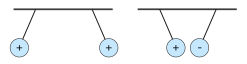
If separated charges are isolated, charges will accumulate. This is called charge accumulation.
This isolation could occur whenever the material of the object is non-conductive or surrounded by non-conductive material.
Any charge accumulation could result in sudden discharge. This depends on the strength of the accumulated charge and the resistance that must be overcome to discharge into another less charged object. This sudden discharge is called electrostatic discharge.
Static electricity in Petroleum Shipping
| examples in daily life | examples in petroleum shipping | |
| Charge separation | Walking across a rug | High liquid flow thru filter Splash loading Flow thru nozzles Small droplets moving (steam or mist) |
| Charge accumulation | Walking (continuous rubbing) on rubber soles causes charge accumulation, because the soles are an isolator | Unbounded objects enabling acc. e.g. objects with fibre ropes, hose with insufficient conductivity… Static accumulator liquids are in use Insufficient relaxation time |
| Electrostatic discharge | The accumulated charge comes close to the earthed doorknob. The charge is discharged thru a spark. | Any kind of accumulation bears the risk of explosion in non – inert atmosphere |