Nomenclature
The international societies namely IUPAC (International Union of Pure and Applied Chemistry) tried to put together a systematic way of naming organic compounds, the idea being that from the chemical name alone, its make-up and structure would be known. The System has been around since the sixties and works well, but unfortunately in everyday life we tend to stick to the old trivial names. The result being that many familiar chemicals have several different names, all actually meaning the Same thing!
Straight chains
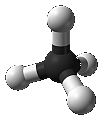
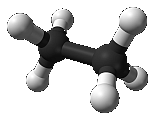
If the molecule has no carbon / carbon double bonds then the last 3 letters of the name of the molecule are:
ALKANE (Methane, Ethane, Porpane etc)
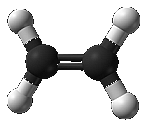
If the molecule has one or more double bonds, then the name of the molecule ends with:
ALKENE (Ethene, Propene, Butene etc – Tradionally known as Ethylene, Propylene, etc)
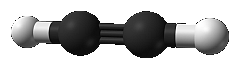
And if the molecule has a triple bond it is designated with the name:
ALKYNE (Ethyne, Propyne etc – Traditionally known as Acetylene, Methyactylene etc).
-
More about straight chains
Number of carbon atoms Prefix Alkanes Alkenes 1 Meth Methane 2 Eth Ethane Ethene 3 Pro Propane Propene 4 But Butane Butene 5 Pen Pentane Pentene 6 Hex Hexane Hexene So far the „straight chain“ or normal hydrocarbons have been considered. Using old terminology, these straight chain or normal alkanes are better known as n-paraffins.
In the case of normal alkenes, the most common name that we have all come across is „olefins“.
As the carbon chain length grows, other permutations become possible:
For example branched chains (iso paraffins) or ring (cyclic) structures.
Branched chains
Unfortunately this is where it all gets a little confusing as we have at least two ways of naming a chemical. The correct name for the above compound is 2-methyl-propane according to IUPAC, but it is far more commonly known as Iso-Butane, especially in the oil industry.
-
More about branched chains
The modern method (IUPAC) counts the longest carbon chain first. In this case it is 3 carbons. It then Looks for „saturation“ or „un-saturation“. In this case, because there are no double bonds, the molecule is saturated. A 3 carbon saturated molecule is called PROPANE. Count which carbon the additional group is attached to. In this case it is attached to the middle carbon of three i.e. carbon number 2. The group attached is a methyl group CH3 (1 carbon + 3 hydrogen). Therefore according to IUPAC the molecule is named:
2 (carbon atom group is attached to)methyl (name of attached group) propane (longest carbon chain type).The older naming system was based an the total number of carbon atoms in the molecule; in this case 4. Therefore the prefix but- applies. As before there are no double bonds so the prefix -ane is added i.e. „butane“. And finally to indicate that this is not normal butane but an isomer the letters iso are added. Therefore the product is named:
iso-butane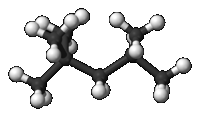 Another important example of a branched alkane is Iso-Octane , otherwise known as 2,2,4 trimethyl pentane:
In molecules such as this, the old system became very misleading as other compounds having 8 carbon atoms could also be described as an „iso – octane“ and this was one of the main reasons why IUPAC was introduced, to eliminate confusing names.
Cyclic chains
Looking onto ring structures or cyclic compounds, there are saturated or unsaturated analogues.
- Saturated.
Cycloalkanes (also calles Naphthenes, if from Petroleum sources). Hydrocarbons containing one or more carbon rings to which hydrogen atoms are attached. Cycloalkanes are cyclopropane and cyclobutane, cyclopentane, cyclohexane, cycloheptane, cyclooctane through cyclotridecane.Cyclohexane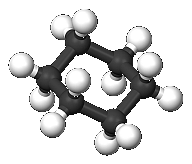
- Unsaturated (have one or more double or triple bonds between carbon atoms):
Benzene: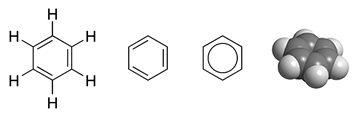 The unsaturated ring system is a very important structure. Chemically very stable and an its own, leading to another very large branch of organic chemistry. In summary chemicals containing the „benzene“ ring are known as Aromatics. The term ‚aromatic‘ was derived from the fact that many of the compounds have a sweet scent.Today benzene is mainly used as an intermediate to make other chemicals. Its most widely-produced derivatives include styrene, which is used to make polymers and plastics, phenol for resins and adhesives (via cumene), and cyclohexane, which is used in the manufacture of Nylon. Smaller amounts of benzene are used to make some types of rubbers, lubricants, dyes, detergents, drugs, explosives and pesticides.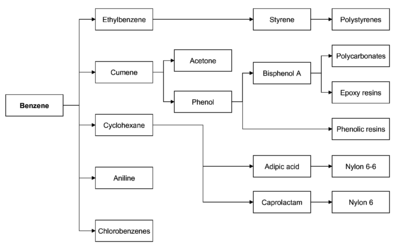
Oxygenated compounds
Oxygen can join the hydrocarbon structures in many different ways. Oxygen always has two bonds and can join the structure by single or double bonds.
Below is a list of the „functional“ groups of oxygen in the hydrocarbon system and their names.
| Functional group | type | name | example | formula |
| C – OH | Alcohol | „ol“ | methanol | CH 3 – OH |
| C = 0 | Ketone | „one“ | propanone | CH3 – CO – CH3 |
| HC = 0 | Aldehyde | „al“ | propanal | CH3 – CH2 = 0H |
| COOH | Acid | „oic“ | propanoic | CH3-CH2-COOH |
| C – 0 – C | Ether | „ether“ | Dimethylether | CH3 – 0 – CH3 |
The two most modern systems were discussed. Even older systematic names are still with us. For example, instead of the prefix eth for a two carbon molecule the name acet is used.
Eg. Acetic Acid (CH3COOH) which is still the most common name today, even though strictly speaking this molecule should be known as ethanoic acid.
Acetic acid is saturated and contains both single and double bonded oxygen molecules.
In the case of unsaturated molecules containing carbon : carbon double bonds (C=C), compounds containing two carbon atoms have still further names:
The (C=C) double bond is traditionally known as „vinyl“ or „acryl„, compared to the more modern names of „ethene“ or „ethylene“. Similarly the cyanide group, (C≡N) is also known as „nitrile„. Using this as an example, we can see that the following molecule has four different names:
IUPAC: Cyanoethene
Alternative 1: Ethylene cyanide
Alternative 2: Vinyl cyanide
Alternative 3: Acrylonitrile
As it is the last alternative turns out to be the „regular“ name for this molecule, i.e. acrylonitrile, even though the name „vinyl“ is still used for other chemicals. The best example being vinyl chloride or its polymer poly vinyl chloride or „PVC“ as it is shortened to.
Acetone is another example of how the older names have remained in common day to day use.
The IUPAC name for this chemical is propanone, although it is also largely known as dimethyl ketone (DMK) as well as acetone.