Reactivity
Self-Reactive (Polymerization)
Substances which polymerise, such as styrene monomer and vinyl acetate monomer, exhibit a unique property which allows individual molecules of a particular substance (monomer) to combine with each other to form long-chain polymers. Most polymerisation reactions are exothermic, and are characterised by an accelerating reaction rate until all of the monomer molecules are consumed. The speed of a polymerisation reaction can be extremely dangerous.
Dangers related to polymerization:
The generation of heat which accelerates the speed of the chemical reaction.
The rapid volumetric expansion of the product causes over pressurisation of the cargo tank with a consequent danger of rupture of the containment system.
The rupture of the tank may lead to chemical reactions with other cargoes in adjacent cargo tanks.
While a monomer cargo may often be a light and volatile liquid in its stable form, the polymerisation process produces heavier and more viscous liquids, or even solids, which may block the tank vents so that the pressure inside the tank increases even further.
Once solidified the polymer occupies a greater volume than the corresponding volume of liquid monomer.
Inhibitor
Cargoes that polymerise will usually contain an inhibitor
These inhibitors are designed to be effective for a set period of time at a specified temperature.
Elevated temperature can reduce the effectiveness of the inhibitor or reduce its effective life.
Keep heat sources away and monitor temperature daily.
Inhibitors usually require oxygen to be effective.
The minimum level of oxygen must be stated on the inhibitor certificate.
As a general rule, a cargo containing an inhibitor that needs oxygen should not be carried in an inerted tank.
Ships carrying inhibited cargoes shall be provided with a certificate of protection from the manufacturer, and kept during the voyage.
Example of a Certificate of protection as required by the IBC code 15.13.3 Inhibition certificate
Reaction with Oxygen
Ethers will form peroxides with oxygen Once peroxides are formed they can act as a catalyst for polymerization reaction Such cargoes should be fully inerted for the duration of the voyage. Carriage temperature as close to ambient as possible.
Vegetable oils can decompose slowly in the presence of oxygen and bacteria (Putrefaction) This process can cause an asphyxiating atmosphere Hazardous Hydrogen Sulphide gas can be produced if oil is in contact with water
Reaction With Water
Isocyanates
The reaction of some chemicals with water, including humidity in the air, can generate gases that are flammable or toxic or both.
Isocyanates, such as Toluene Di Isocyanate (TDI), react violently with water to form carbon dioxide, an asphyxiating gas.
The reaction can also lead to over-pressurisation of the tank.
Such products including the pipeline system should be kept separated from water and be carried under a dry atmosphere
Neither steam nor water should be used to control the temperature
Water as an initial cleaning medium should be avoided.
Acids
Water can significantly increase the corrosiveness of some acids. Sulphuric acid is resistant to stainless steel only if the conc is > 96%
Dilution of acids with water will lead to a temperature increase
For cleaning a large amount of water needs to be introduced to quickly dilute and absorb heat.
For any other dilution of acids never add water to acid. Instead, small amounts of acid should be added slowly to the water,
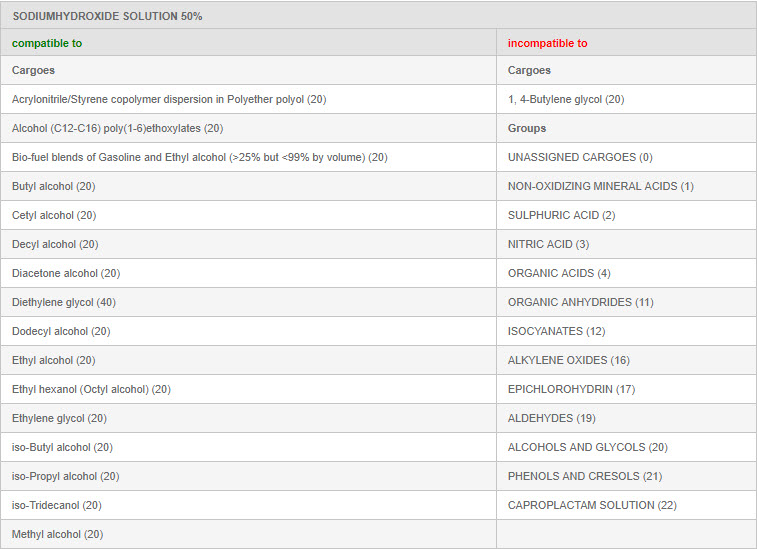
Incompatible cargoes
Cargoes, which react in a hazardous manner with other cargoes, must:
Be segregated from such other cargoes by means of a cofferdam, void space, cargo pumproom, other pumproom, empty tank, or tank containing a mutually compatible cargo
Have separate pumping and piping systems which must not pass through other cargo tanks containing such cargoes, unless encased in a tunnel
Have separate tank venting systems
MIRACLE Database provides information about cargo compatibility for most products in the section Adjacent Cargo Compatibility