Flammability
Fire
3 elements are necessary to create a fire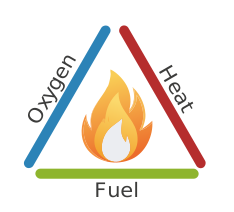
–Fuel (Some sort of fuel or combustible material)
–Oxidiser (Enough oxygen to sustain combustion)
–Source of ignition (Enough energy to activate the reaction)
Once a fire has started usually it delivers enough energy to sustain the fire
If one of the 3 elements is not present, a fire cannot start. If one of the 3 is taken away the fire will be extinguished.
-
Tutorial video about fire
3 elements are necessary to create a fire
Inert atmosphere
Inertisation or Inertization with Inert Gas or Nitrogen is the lowest risk for operation with flammable cargoes but High Risk for humans due to the Asphixiation hazard
Sources of ignition
An effective countermeasure for fire is to eliminate ALL ignition sources
Common ignition sources on board of tank ships
Static electricity
Sparks from rotating equipment
Sparks from tools
Smoking
Flammability
In the process of burning, hydrocarbon gases react with the oxygen in the air to produce carbon dioxide and water. The reaction gives sufficient heat to form a flame, which travels through the mixture of hydrocarbon gas and air. When the gas above a liquid hydrocarbon is ignited, the heat produced is usually enough to evaporate sufficient fresh gas to maintain the flame, and the liquid is said to burn. In fact, it is the gas that is burning and is being continuously replenished from the liquid.
Flammable Limits
In practice, the Lower and Upper Flammable Limits of oil cargoes carried in tankers can, for general purposes, be taken as 1% and 10% by volume respectively.
Flashpoint
The flashpoint is the lowest liquid temperature at which the small flame initiates a flash of flame across the surface of the liquid, thereby indicating the presence of a flammable gas/air mixture above the liquid.
-
Flammability classification
There are many schemes for dividing the complete range of petroleum liquids into different flammability classes based on flashpoint and vapour pressure and there is a considerable variation in these schemes between countries.
ISGOTT
–Non volatile Flashpoint 60°C or above
–Volatile Flashpoint below 60°C
IBC Code Chapter 21
21.7.11 Flammable cargoes

21.7.11.1 A cargo is defined as flammable according to the following criteria:IBC Code descriptor Flashpoint ° C Highly flammable < 23 Flammable <=60 but >=23

-
Flammability classification acc to NFPA
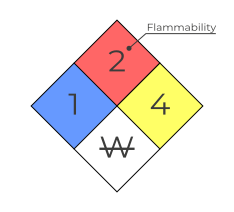
NFPA Diamond Rating Degree of flammability Flashpoint Examples 0 Materials that will not burn NA water 1 Materials that must be preheated before they will ignite Above 200°F or 93.3°C lubricating oils, cooking oils 2 Materials that must be moderately heated or exposed to relatively high ambient temperatures before they will ignite 100 – 200°F or 37.8 – 93.3 °C diesel fuel 3 Liquids and solids that can ignite under almost all temperature conditions Below 100°F or 37.8°C gasoline, acetone 4 Materials which will rapidly vaporize at atmospheric pressure and normal temperatures, or are readily dispersed in air and which burn readily Below 73°F or 22.7°C natural gas, propane, butane
-
Flashpoint Measurement
Tests involve gradual heating of the material sample in a pot. A small flame is repeatedly applied to the surface of the liquid. At the moment when a small flame initiates a flash across the surface of the liquid the temperature is recorded. This is the flashpoint.
Open cup
–Surface is permanantly open to the atmosphere.
–More inaccurate results.
–Flashpoint about 6° higher than in closed cup deviceClosed cup
–Space above liquid is closed except the brief moment when the initiating flame is applied.
–Most accurate measurement and generally favoured
-
Tutorial video about inertization& flammable range & limits
Flammable range