Water miscibility
Hydrocarbon test or water miscibility test
The purpose of this test is the qualitative detection of non-water-soluble contaminants. It works on the basis that many impurities are soluble in the wallwash liquid (Methanol, Acetone) but not in water. Sometimes this test is also called Hydrocarbon test.
A small amount of wallwash liquid is poured into clear water. The wallwash solvent is soluble in water but not the impurities. Therefore the impurities will lead to cloudiness or turbidity of the water.
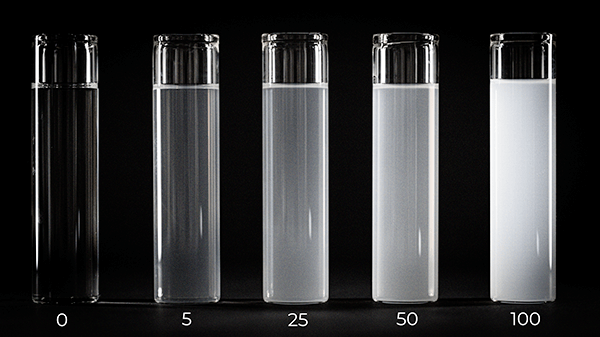
The water with wall wash liquid is compared with pure water. If there is any turbidity after 30 minutes there are still hydrocarbons on the tank surface.
Turbidity after Water Miscibility Test. The digits refer to Formazin Turbidity Units (FTU). The test result can be analysed with the UV-Spectrometer in Visible Light Mode. The device will deliver the result in FTU.
-
Detailed description
SUMMARY OF THE TEST METHOD
Hydrocarbons in water give a milky cloudy solution. Depending on the hydrocarbons, the solution will be bluish to white cloudy.EQUIPMENT
- Following equipment should be available:
- Nessler tubes 100ml.
- Distilled water chloride free
- Pure laboratory Methanol
- Penlight.
CLEANING EQUIPMENT
Use throwaway gloves. Clean tubes thoroughly.PROCEDURE
Fill a clean Nessler tube with 25 ml from the wallwash sample. Add 75 ml de-ionised water. Insert stopper, invert once to mix the contents and allow it to stand for 20 minutes. At the same time prepare a standard solution of 25 ml pure laboratory Methanol and 75 ml de-ionised water. Place the tubes on a black surface. Make the room dark and shine light through the side of the tubes by means of a wide beam flashlight, while looking down through the liquid columns.
Frequently a penlight is used for this test which makes the evaluation far closer to the Tyndall test. This makes the test far more sensitive due to the intensity of the light beam. Please also note that the reference sample might even show a faint whitish trace when using a penlight.RESULT
Any difference between the reference sample and the wall wash sample means the sample has “failed” for the presence of hydrocarbons. If a bluish tint is present, there are moderate to heavy hydrocarbons. If a whitish haze is observed, this usually indicates slight hydrocarbons.NOTES
Factors that might affect the test are :- Bulkhead being damp
- Dirty Nessler tubes
- Blue graduation numbers on the tube.