Wall Wash
Wall wash test
This describes an approved method for collecting and analysing wall wash samples to determine the presence of contaminants on the bulkheads. The procedure involves contacting a constant area of the bulkhead with a given amount of specification grade methanol, collecting the liquid and analysing it for the presence of chlorides, hydrocarbons, colour and particulate matter, whatever might be required by the charterer. 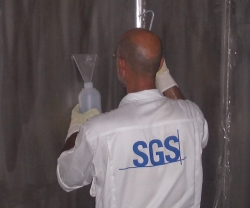
-
Wall wash procedure
PRECAUTIONS
Safety Considerations – eye protection is required when collecting the samples to prevent the inadvertent contact of methanol with the eyes during the sample collection process. Gloves should be worn to prevent the absorption of methanol into the skin.
Disposable plastic gloves are also worn to prevent contamination of the samples during the collection process. (A sufficient amount of chlorides can be absorbed from the skin to cause the sample to fail the chloride analysis.)
Chlorides are abundant in the marine environment. All sampling equipment including bottles, funnels and other apparatus must be thoroughly rinsed with methanol (of less than 0.2 ppm chlorides content) and stored in plastic containers. Bottles are to be capped prior to sample collection.
Personnel collecting the samples must be certain that no perspiration or bare skin contacts the sample or sampling equipment while the wall washes are being collected.
CHOICE OF TEST SITES
As a minimum, four sites of approximately 1.2 square feet each must be chosen in each tank. (If additional sites are chosen, 100mls of methanol should be applied to each location and collected in a separate container.)
Any area that appears to have crystalline deposits should definitely be tested. A separate test of non-typical areas greater than 2 square feet (discoloured patches etc.) should be conducted. The sample collected should be labelled with a description of the non-typical area. (These areas should be analysed separately.)
SAMPLE COLLECTION PROCEDURES
Choose four surfaces to test.
Using the plastic wash bottle, squirt methanol on the test section at the highest practical point (normally 1.5 up to 2 metres) above the tank bottom in a stream of about 10cm wide.
Allow the methanol to run down the wall approximately 15 cm and begin collecting it with the funnel, squirting additional liquid as necessary to rinse the flushing into the sample funnel. Continue this process until approximately an area of 10 by 120 cm has been rinsed with 100 mls of methanol.
After the washings from the four sites are collected, submit a portion of the sample for analysis of chlorides, colour, suspended matter and hydrocarbons, whatever is applicable.
The accuracy of this test depends upon consistency.- Consistent number of sites tested.
- Consistent area tested at each site.
- Consistent amount of methanol applied to each site.
- Consistent amount of methanol recovered from each site.
For the purpose of standardising methods and maintaining the desired consistency; the following criteria have been established:
- Four wall wash sites.
- An area of 10 by 120 cm for each wall wash.
- 100 mls of methanol applied to each site.
-
Wall wash test kit
-
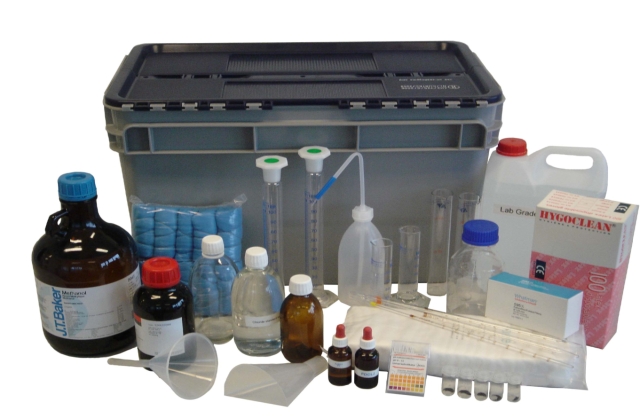
The Wall Wash Test Kit is a complete test kit for performing a hydrocarbon test, PTT time test, chloride test, pH test, a acid wash colour test and stainless steel passivation test. Packed in a UN-approved – heavy duty – poly ethylene box for safe storage. The test kit consists of the following:
Lab Grade Methanol – 8045 (2.5 ltr glass bottle)
Lab Grade D.I. Water (5 ltr)
Potassium Permanganate Crystals – 0.1 gram (5 ampules)
Chloride Standard Solution (500 ml)
Sulphuric Acid Concentrate (500 ml)
Hydrochlorid Acid Concentrate (500 ml)
Standard Solution (500 ml)
Silver Nitrate – 5% Solution (30 ml drop bottle)
Palladium Chloride Reagent (30 ml drop bottle)
pH Strips – range 0-14 (100 pcs)
Cotton Wool
Filter Paper – folded – 100 pcs (Whatman)
Latex Gloves (100 pcs)
Shoe Covers (100 pcs)
Squirt Bottles – 500 ml
Funnel – Round
Funnel – Flat Sided
Pipette – plastic 3ml (10 pcs)
Shaking Cylinders (2 pcs)
Measuring Cylinders (2 pcs)
Nessler Tubes (2 pcs)
Volumetric Flask
Pipette – glass 1ml
Pipette – glass 5ml
Pipette – glass 10ml
Instruction Manual
Will Methanol be banned as a Wall Wash Liquid for safety reasons?
With the new IBC Code 2020, Methanol has been classified as toxic cargo
The changes in the IBC code have only effect on the cargo Methanol.
The toxicity of the laboratory chemical has not changed. There is no additional risk associated with using methanol for wall wash after the 1st of January 2021.
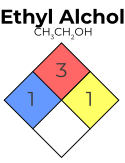
If safety concerns are present after re-assessing the risk, potential substitutes are Acetone and lab-grade Ethanol.
Wall Wash Liquid Comparison
| Methanol | Acetone | Ethanol | |
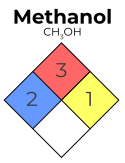 |
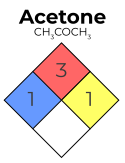 |
 |
|
| SDS | Highly flammable liquid and vapour | Highly flammable liquid and vapour | Highly flammable liquid and vapour |
| Toxic if inhaled | Causes serious eye irritation | ||
| Toxic in contact with skin | May cause drowsiness or dizziness | ||
| Toxic if swallowed | |||
| Causes damage to organs (Eyes, Nervous system) | |||
| IBC code | Toxic due to long-term health effects | Not toxic | Not toxic |
| Low cost | Not suitable for Chloride Test | High cost | |
| Not suitable for UV Scan |
Hazards and Prevention Phrases from Methanol SDS
Hazard Phrases
H225 Highly flammable liquid and vapour
H331 Toxic if inhaled
H311 Toxic in contact with skin
H301 Toxic if swallowed
H370 Causes damage to organs (Eyes, Nervous system)
Prevention Phrases
P280 Wear protective gloves/protective clothing/eye protection/face protection.
P210 Keep away from heat/sparks/open flames/hot surfaces. – No smoking.
P243 Take precautionary measures against static discharge.
P303 IF ON SKIN (or hair):
P361 Remove/Take off immediately all contaminated clothing.
P353 Rinse skin with water/shower.
P304 IF INHALED:
P340 Remove victim to fresh air and keep at rest in a position comfortable for breathing.
P301 IF SWALLOWED:
P310 Immediately call a POISON CENTER or doctor/physician.