Washing Water Analysis
Washing Water Analysis
Washing Water Analysis with UV spectrometer allows to monitor the results of washing process during and after the cleaning.
The washing water analysis means taking samples from the washing water effluent during the washing process and analyzing the sample with a UV spectrometer. This allows a fast and efficient control of the cleaning process without interruption and confined space entry.
The underlying principle is the concentration measurement of cargo remainings in the wash water.
An effective cleaning method will remove cargo clingage from tank and pipeline surfaces. Thus the washing water will contain a certain amount of the cargo.
A small quantity from the wash water sample introduced into the UV spectrometer delivers a curve (UV Wavescan) that indicates both, the magnitude of the concentration and the type of the cargo. The height of the peak indicates the concentration, the shape of the curve is typical for the cargo that was in the tank.
Significant conclusions are possible from interpretation of this information.
UV Wavescan
Exemplary cleaning operation monitored with washing water analysis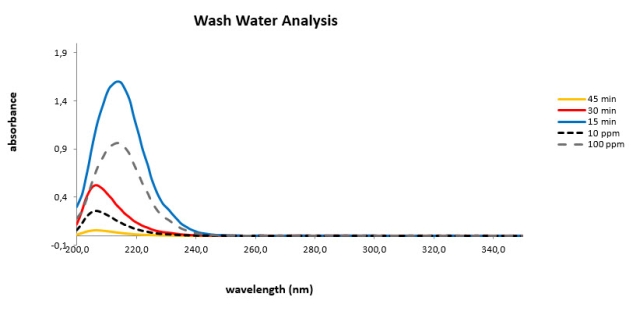
Blue line: Sample after 15 min shows a significant concentration of previous cargo. This indicates that the cargo is transported by the washing water out of the tank.
Red line: After 30 min a remarkable reduction of the concentration is observed.
Yellow line: A nearly flat line after 45 min indicates that no cargo is transported anymore out of the tank.
The dashed lines are standards that are available for many cargoes. Comparison with those allows instantaneous assessment of the removed quantity. Sampling in regular time intervals allows monitoring of the progress. In this example the cleaning step can be finished after 45 min. No cargo is removed anymore. If this is water soluble cargo it means the tank is clean. If this a non water soluble cargo it means continuation will not improve anything. It could mean go to next step.
Comparison Wall Wash Test and Washing Water Analysis
The measurements from washing water analysis are undoubtful more relevant than those from a wall wash test.
WWT controls the cargo that is left after cleaning. The WWT sample is taken from a surface area that is far less than 1% of the tank surface. It is always uncertain whether the controlled area is representative. The monitored area and the used quantity of Wall Wash liquid is not determined. Thus the measured concentration does not allow to determine the quantity of the cargo that is left.
Sampling is only possible after the cleaning operation and requires always a confined space entry.
Washing water analysis measures the cargo that has been removed from the tank. Washing water analysis allows reliable monitoring of the entire system, not just some spots.
Monitoring is possible anytime during the tank cleaning operation. Frequent sampling and measuring allows to determine the optimal cleaning time during every cleaning step.
Substantial energy savings are possible for cleaning of cargoes requiring hot wash, because the required minimum cleaning time can be measured.
Washing Water Analysis is not a carefree package
Cargo that is not washed from the system will not be discovered by neither the wall wash test nor by the wall wash analysis. Such cargo residues will remain in the system and probably cause a contamination of the next cargo.
The term system is used here for a good reason. It is not just the tank and pipelines. Systems means the entire equipment that was in contact with the cargo and that will be in contact with the next cargoes.
Examples of potential problem areas:
Cleaning step does not remove a non water soluble cargo.
Shadow areas not reached by the water jet from cleaning machine.
Dead ends in the pipelines
Tank coatings retaining cargo
Some cargoes cannot be detected because they don’t absorb enough UV light. In most cases the Washing Water Analysis is still applicable using alternative detection methods.