Epoxy
Epoxy Coating
The different epoxy types, e.g. pure epoxy, phenolic epoxy and isocyanate epoxy form cross-linkages to different degrees resulting in relatively good resistance to a greater range of cargoes.
Highest resistance against chemicals have phenolic epoxy (Epoxy Novolac) resin films.
In contrast to inorganic zinc paints, epoxy systems are resistant to strong alkalies and do not absorb oil-like substances.
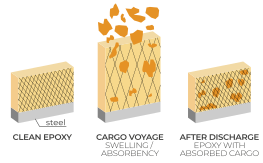
Epoxy coatings tend to absorb, however, solvent-like cargoes (Resistant with limitations according to coating resistance list). This absorption is caused by swelling and subsequent softening of the coating.
Water may not be used for cleaning until this ventilation process is finalized. Otherwise the water can lead to blistering and chemical reaction of the water with the coating with subsequent serious damage of the coating.
The more solvency power a cargo has, the more cargo residues could still be present in the coating. This could lead to either contamination of the next or after next cargo or breakdown of the coating film.
- Resistant to strong bases
- Does not retain oil like cargoes
- Solvent like cargoes are absorbed but not completely desorbed after ventilation
- Adsorbed residues can be solved by wall wash test
- Residues can result in contamination of next or after next cargo
- Water wash before thorough ventilation and desorption of residues could result in serious damage of the coating (especially at elevated temperatures)
-
Aggressive cargoes will soften the coating
These cargoes can cause softening and swelling of the coating system. The coating will however recover hardness as the cargo evaporates from the coating, after unloading. The stowage time for these cargoes must not exceed the number of days specified by the coating supplier. After unloading of these cargoes, the tanks should not be brought into contact with water or steam before the coating is restored to its original condition.
This may be obtained by ventilating the tank with dry air until it is in a steady state gas-free condition.
After ventilation, loading of further aggressive cargoes, aqueous cargoes, or ballast water cannot take place within number of days specified by the coating supplier.If one of the major coating suppliers has classified this cargo as aggressive, MIRACLE indicates a warning in the cleaning section for this cargo. If this warning is indicated it should be checked if the warning is applicable for the coating of the respective tank.
Aggressive cargoes will be retained in the coating.
-
Absorption/Desorption
The instructions from the coating supplier have to be followed.
As described above, aggressive solvent-like cargoes will cause softening and swelling of the epoxy film. The swelling factor depends on the chemical resistance of the coating against the cargo.
Examples for cargoes with high swelling factor are Methanol, EDC, Acetone, Vinyl Acetate Monomer and Cyclohexanone.
The swelling reduces the density of the coating and enables the cargo molecules to migrate into the coating. It is believed that some cargoes are even chemically bonded to the coating by molecular forces.
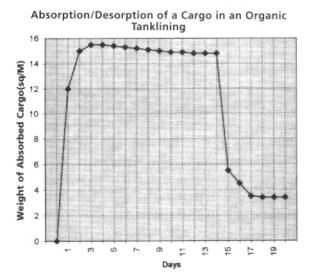
Typically that the cargo is absorbed within a couple of days to the maximum (equilibrium) level and stays constant for the remainder of the voyage. The absorption rate and the amount of cargo absorbed depend, as always, on the type of cargo.
The desorption (removal) of the cargo residues from the coating by ventilation starts also at a rapid rate. After a couple of days there is no significant further loss of the retained cargo. Unfortunately the desorption comes to a standstill before all cargo has been released by the coating. The remaining amount varies depending on coating type, film thickness and type of cargo.
This retained cargo is of critical importance, because it could be the cause for following cargo contamination, if this cargo is able to dissolve the residues. The retained amount can lead easily to concentrations of some 50 to 100 ppm in the following cargo, which is clearly too much for high quality cargoes. (See example below)
 If residues are remaining they will probably be solved during a wall wash with Methanol, because the Methanol lets the coating swell again and the high solvency power will extract the residues.
Cleaning of epoxy coated tanks If the coating is not soft, ventilation is not necessary and the cleaning should be performed as indicated for the cargo in the Cleaning Proposal section.
If the coating is soft, tank should be ventilated for at least 24 hours after discharge or longer, if the coating system has not fully recovered. The desorption of a cargo can be accelerated by higher temperatures. The desorbed cargo has to be transported away from the tank wall. Cargoes with a vapour density higher than air have to be removed by forced circulation to avoid accumulation on the tank bottom
Ventilation must provide moisture-free dehumidified air to the lowest point of the tank. Likewise, extraction ducts must also reach the lowest point of the tank to help remove the solvent vapours.
Water and steaming should not be used before full recovery of the coating system to avoid adverse effects on the coating.
Next cargo Aggressive solvent-like cargoes causing softening of the coating should not be sequenced more than once.
Water containing cargoes should generally not be carried after solvent-like cargoe
For further details pls refer to instructions from coating supplier.
-
Contamination calculation (example)
Typical amounts of cargo measured in coating after ventilation/cleaning:
Cargo % absorbed
kg cargo/
kg coatingMethanol 4 Vinyl Acetate Monomer 5 EDC 3 Styrene Monomer 6 Typical weight of coating: 1 kg coating/m2 tank wall
Typical surface to volume ratio: 1 m2 surface :1 m3 tank volume
Typical density of cargo 1000 kg/1 m3 (specific gravity = 1.0)
Concentration (ppm) = [% absorbed * 10E –2 * Surface/Volume * 1000] * 10E 6
From this formular a general rule can be derived: 1% absorbed previous cargo could cause a concentration of 10 ppm in next cargo, if completely dissolved