Stainless Steel
Corrosion resistance
The high corrosion resistance of stainless steels is based on their ability to form a protective passive layer of chromium oxides and hydroxides which generally develops
immediately in the presence of air or water.
Corrosion attack can occur when the passive layer is broken or destroyed locally or over the entire surface under the effect of an aggressive medium such as Phosphoric Acid with high chloride and flouride content or Sulphuric Acid in lower concentration
-
More details about corrosion resistance
Stainless steels will naturally self-passivate whenever a clean surface is exposed to an environment that can provide enough oxygen to form the chromium-rich oxide surface layer.This occurs automatically and instantaneously, provided there is sufficient oxygen available at the surface of the steel. The passive layer does however increase in thickness for sometime after its initial formation. Naturally occurring conditions such as contact with air or aerated water will create and maintain the corrosion resisting passive surface condition.In this way stainless steels can keep their corrosion resistance, even where mechanical damage (e.g. scratching or machining) occurs and so have an in-builtself-repairing corrosion protection system.
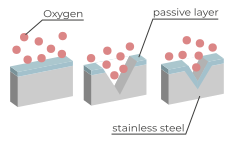
Stainless steels cannot be considered corrosion resistant under all service conditions. Depending on the type (composition) of the steel there will be certain conditions where the passive state is broken down and prevented from reforming. Here the surface becomes ‚active‘, resulting in corrosion. On stainless steels active conditions can occur in small areas deprived of oxygen, such as at mechanical joints, tight corners or at incomplete or poorly finished welds. The result can be ‚localised‘ forms of crevice or pitting attack.Especially during transport of cargoes in chemical tankers conditions can occur that result in chromium depletion and consequently in ‚active‘ surfaces resulting in corrosion. Pickling or Passivation are required to restore the ‚passive state‘ of the surface.
Pickling & Passivation
Stainless steel can corrode in service if there is contamination of the surface. Both pickling and passivation are chemical treatments applied to the surface of stainless steel to remove contaminants and assist the formation of a continuous chromium-oxide, passive film. Pickling and passivation are both acid treatments and neither will remove grease or oil. If the steel is dirty, it may be neccesary to use a detergent or alkaline clean before pickling or passivation.
-
Pickling
Pickling is the removal of any high temperature scale and any adjacent low chromium layer of metal from the surface of stainless steel by chemical means. Where the steel has been heated by welding, heat treatments or other means, to the point where a coloured oxide layer can be seen, there is a chromium depleted layer on the surface of the steel underneath the oxide layer. The lower chromium content gives lower corrosion resistance. To restore the best corrosion resistant performance, the damaged metal layer must be removed, exposing a fully alloyed stainless steel surface. Mechanical removal may leave abrasive or other particles embedded (interfering with corrosion performance) or may be impractical, so chemical means are usually employed.
Procedures incorporating pickling solutions of nitric (HNO3) and hydrofluoric (HF) acids remove the scale and the underlying chromium depleted layer and restore the corrosion resistance. Pickling solutions also remove contaminants such as ferrous and ferric oxide particles. Pickling solutions other than mixtures of nitric and hydrofluoric acids exist and can be used for specialised applications.
Pickling involves metal removal and a change or dulling in the visual brightness of the metal.
-
Passivation
Stainless steel surfaces tanks on chemical tankers should be checked regularly for an intact passive film. This can be done with the Palladium Chloride Test.
Passivation is the treatment of the surface of stainless steels, often with acid solutions (or pastes), to remove contaminants and promote the formation of the passive film on a freshly created surface (eg through grinding, machining or mechanical damage).
Common passivation treatments include nitric acid (HNO3) solutions or pastes which will clean the steel surface of free iron contaminants. Care must be taken in selecting and using passivation treatments to ensure the selected treatment will target the contaminant. Passivation will also aid in the rapid development of the passive oxide film on the steel’s surface. Passivation does not usually result in a marked change in appearance of the steel surface.
-
Safety
Pickling and passivation use strong acids, and normal precautions for safety should be followed. Consult Materials Safety Data Sheets and product packaging for detailed advice. Stainless pickling acids are highly corrosive to carbon steel.
It is essential that all acids are thoroughly removed by rinsing the component after completing the process. Residual hydrofluoric acid will initiate pitting corrosion.
-
Palladium Test
The Palladium Chloride test serves to check the passivity of the stainless steel surface. A test kit is necessary to carry this test out. For supply of the test kit contact for example Marine Care B.V.
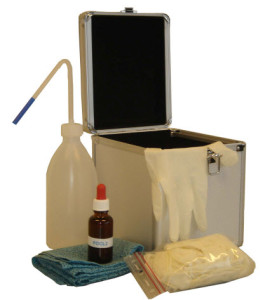
Passivation test kit - Clean the area to be tested with bottles distilled water, using the cotton from the test kit.
- Dry the area with cotton. Make the surface free of grease}
- Apply 1 drop Palladium Chloride solution with drop pipette on the area
- Let the drops act for 2-3 minutes
- If the area is not coloured, the metal is passivated.
- If the area becomes grey, the metal is medium passivated. Light grey colour is doubtful and how darker the colour the worse the stainless steel.
- If the area becomes black, the metal is active and has to be passivated.
- On the test completion wash the area where Palladium Chloride solution has been applied with distilled water. The solution is an acid reagent and will cause pitting in the area where it was applied.
- The Palladium Chloride Solution can be tested by making a small sharp scratch with a knife. Do the test on the scratch. The scratch has to be coloured black.
Palladium Chloride reaction
Palladium Chloride can be solved in Water to an aqueous solution > Palladium Chloride Solution, which is colourless. This Palladium Chloride solution can be reduced easily to metallic Palladium, which is black. This is what happens, if free Iron (not oxidized Iron) is present on the steel surface. Iron is oxidized by the Palladium Chloride to Iron Oxide.4PdCL2 + 4 H2O + 3Fe > 4Pd + 8 HCl + Fe3O4
-
Passivity tester - Oxilyzer 3
Digital meter for measuring the passivity of stainlees steel
- Simple and robust device – Just a small meter with 2 cables
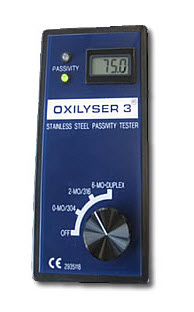 and a shockproof electrode
 - Easy to understand – Takes 5 minutes to understand the procedure
- Effective method – Just the type of steel measured must be known
- Accurate results – Green light : OK. Red light : Not OK. Additional info from digital reading
- Replaces the palladium chloride test
- For oxilyser contact Marine Care B.V.
- Simple and robust device – Just a small meter with 2 cables