Cleaning Machines
General
The cleaning machine is the most important equipment and its proper operation is a key success factor for achieving the desired cleaning results.
Tank cleaning by means of automated machines is often named „Butterworthing“. Arthur Butterworth, in 1920, patented the first Automated Tank Cleaning Machine. Nowadays there are several manufacturers of tank cleaning machines.
Usually the manufacturer of the machines plans the number of necessary machines, the size of the machine and their location, depending on the dimensions and the geometry of the tank and the internals of the tank. The resulting design of the cleaning system minimizes so-called shadow areas.
All recommendations regarding tank cleaning in MIRACLE are based on the assumption that the tank is equipped with a thoroughly designed tank cleaning system.
Single Nozzle and Dual Nozzle
A crucial design criterion of the tank cleaning machine is the number of nozzles
Most types are Single Nozzle or Dual Nozzle.
Main differences are:
| Single | Dual | |
| Picture | 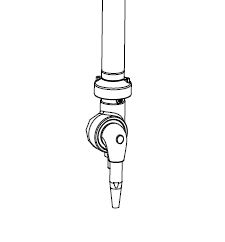 |
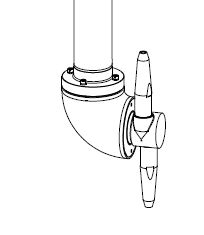 |
| Number of nozzles (Hits) | 1 (one hit always) | 2 (two hits always) |
| Speed | Slower coverage of tank | Faster coverage of tank |
| Impact | High impact long throw length | Lower impact |
| Operation | Programmable | Variable cleaning time |
| Cleaning pattern | Helical
Single nozzle – dense pattern |
Criss-Cross
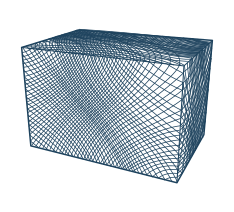
Dual nozzle – 4 cycles |
| Temperature | Only cleaned section hot | Keeps entire tank hot |
| Consumption (water and cleaner) | Higher | Lower |
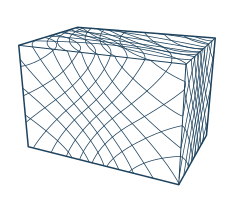
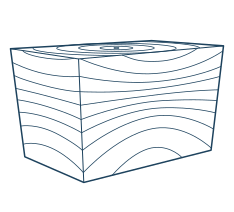 Single nozzle – course pattern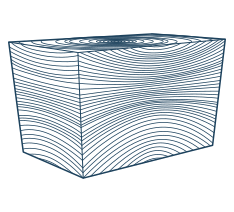
Adjustment of the machine
Both the single nozzle and dual nozzle machines generate a so-called track pattern on the tank walls. The pattern can be course or dense. As a general rule, the tougher the cleaning job, the denser must be the pattern.
A single nozzle machine has usually 4 different cleaning programs. The operator has to select the correct program. Typically program 1 generates the densest pattern and program 4 the coarsest pattern.
Dual nozzle machines do not require a program. Just the cleaning time determines the pattern. Most dual nozzle machines run 4 cycles to generate the densest pattern.
The tougher the cleaning job, the denser must be the pattern.