Cleaning Process
Introduction
Tank cleaning and gas freeing are amongst the most dangerous operations that are carried out on board a chemical tanker. During tank cleaning there is an increased risk from exposure to the many different chemical products involved, and from the physical dangers associated with the operation.
Planning
Properties Next cargo Conditions & Hardware Tank Cleaning Recipes Inspection of results
Planning a tank cleaning operation is the key to success. Planning should be carried out by qualified people only. Planning the cleaning operation should be kept in mind even before loading the cargo, to avoid potential adverse effects from adjacent cargoes.
Proper preparation of the cleaning operation will avoid tank rejections as well as incidents during the operation. In general the cleaning procedure can be determined from the product properties of the product to be cleaned, the surrounding conditions, the available equipment and the requirements of the product to be loaded.
Sufficient tank cleaning should be performed after every discharge, irrespective of the next cargo to be loaded. Contamination problems resulting from insufficient cleaning could be carried on to the cargo after next or even further.
A pre-cleaning meeting should be held before operation commences.
Planning of tank cleaning is required to address all these factors:
-
Physical Properties
- Water miscibility
- Melting Point
- Viscosity
- Vapour
- Pressure
- Boiling Point
- Flash Point
- Flammability
- Density
-
Product Characteristics
- Polymerization
- Evaporation of volatile substances
- Reaction with water
- Reaction with oxygen
- Reaction with water hardness compounds
- Smell
Required cleanliness standard of the cargo to be loaded (next cargo)
The requirements of the product to be loaded must be known. The cleanliness requirement of the next cargo is of prime importance for the intensity of the cleaning operation. The trade pattern of the vessel will be either chemical trade or CPP/DPP trade. The cleanliness standards are very different in these trades.
In the Chemical Trade the next cargo could be significantly different from the previous cargo, so that a minimum of tank washing is always executed. The cleaning standards are Visually Clean, Water White, High Purity and Ultra High Purity. More details about these standards can be found here.
In the CPP/DPP trade the cleaning requirements are usually much less. After certain cargo combinations cleaning is not required at all, due to the similarity of these cargoes.
-
Surrounding conditions (temperatures)
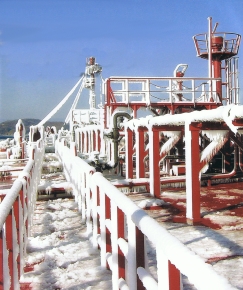
Winter navigation Surrounding conditions such as outside temperature, sea water temperature and adjacent cargo as well as ballast temperature should be reviewed and taken into consideration.
-
Tankwall surface condition (stainless steel or coating)
The surface of the materials that were in contact with the product to be cleaned must be reviewed. Since most chemical tankers have nowadays stainless steel tanks, this is considered as the standard case. Coated and especially zinc-coated tanks require special attention and thus have a separate chapter. More information about coatings
-
Available cleaning hardware (cleaning machines)
The available hardware and its capability/restrictions must be considered carefully. The most important tool during tank cleaning operation is obviously the tank cleaning machine(s). More details about cleaning machines
-
Cleaning of all equipment that was in contact with cargo (valves, lines, dead ends etc.)
All parts of the system that were in contact with the cargo must be cleaned. A common mistake is to place emphasis just on the tank itself. Cleaning the entire system including pumps, pipelines and valves is as important as cleaning the tank
Tank Cleaning Recipe
After careful review of the properties and conditions as mentioned above the cleaning steps can be planned in detail.
The resulting tank cleaning recipe is divided into tank cleaning steps. Each step consists of the operating parameters, the cleaner and the cleaning medium and additional remarks.
The operating parameters are:
- Method (Butterworth, Recirculation, Rinse, Vent)
- Time. Duration of the step in hours. Obviously the required cleaning time varies with the available hardware and the tank size and design. The times indicated in the database are for a typical stainless steel tank of some 1000 m3. If the tank to be cleaned has a much different size, the times must be increased or can be decreased accordingly.
- Temperature Ambient : Cold up to max 30°C. Warm : 35 – 45°C. Moderate : 50 – 65°C. Hot : 75 – 80°C For some substances it is necessary to define a more narrow temperature range, to avoid adverse effects such as exceeding of flash point.
- Medium. Sea water, fresh water, treated fresh water, demi water, chemicals/products (e.g Methanol, Methylene Chloride etc.)
- Cleaning agent, if required. Some cargoes require the use of a cleaning agent for efficient cleaning. Most cleaning agents are additives that are used in combination with water to improve the water solubility of the cargo to be cleaned. A variety of cleaning agents is available for most application problems. Cleaning agents must be IMO approved
- Remarks. The remark describes safety precautions
| Step | Method | Time | Temperature | Medium | Cleaner | Step Remark |
| 1 | Butterworth | 0,5h | ambient | Sea Water | Ambient temp due to flammability of cargo | |
| 2 | Recirculation | 1,5h | moderate | Fresh water | 0.5% cleanerXYZ | |
| 3 | Rinse | 0,2 h | ambient | Fresh water |
The first cleaning step, also called pre-cleaning, is usually carried out without cleaning additives in order to remove the major amount of product residue. The sooner the first step is carried out after discharge the easier product residues will be removed. The first step is highly important, because it could be very difficult to obtain a satisfactory result after an initial mistake. For example an excessively high pre-cleaning temperature could lead to an undesired chemical reaction that is irreversible, such as polymerization.
The tank cleaning recipe should be documented in the Tank Cleaning Plan.
Before starting tank cleaning operations, the responsible officer should hod a meeting to review of the tank cleaning plan with all crew members involved
Inspection of results
After the final cleaning has been accomplished it is necessary to check whether the desired result has been achieved. The tank must be inspected visually for product residues. More details about how to inspect the tank can be found here
If the next cargo requires a high purity standard, a wall wash test must be carried out. Since many contaminations result from insufficient cleaning of valves and pipelines they should be inspected as well by opening flange connections, dismantling of valves and opening dead ends if possible.
If tankwalls are discolored or show rust stains it might be necessary to carry out a pickling operation or passivation.
If unsatisfactory cleaning results have been identified during inspection of the tank, additional methods such as Hand Spray must be applied.
A list of frequently occurring problems and their remedies is listed in the troubleshooting section